
Photo Credit: Joel & Jasmin Førestbird
In September, the Federal Reserve raised interest rates for the first time since 2023. Markets expect another increase at the December meeting, with the potential for additional rate hikes in early 2027. Higher rates can make borrowing more expensive for consumers and businesses, raising questions about the potential impact on stocks, but history offers a more balanced answer. Since 1990, the Fed has started six tightening cycles, and the S&P 500 was higher 12 months later in 5 of those 6 periods.
Figure 1 shows the S&P 500’s return in the 12 months after the first rate hike of each cycle. The average gain was +9%, although that figure is boosted by a strong +40% return during the 1997 cycle. The more typical outcome was a modest gain, with a median return of +5%. The only decline came in 2022, when the S&P 500 fell -9% over the following year. That tightening cycle was unusual: inflation exceeded 8%, its highest level in four decades, and the Fed raised rates seven times in 2022 alone. In earlier cycles, the Fed began raising rates while inflation was around 3% or lower, and the economy was strong enough to absorb higher borrowing costs.
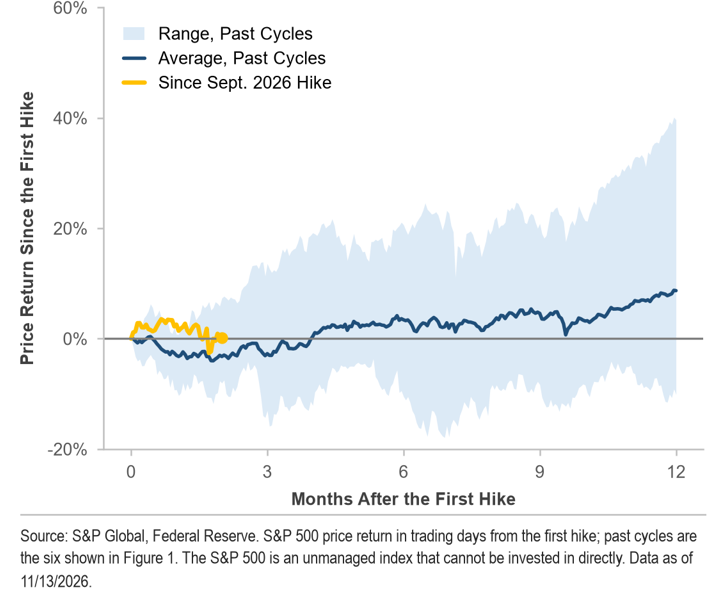
While stocks generally finished higher, the gains did not always come in a straight line. Figure 2 graphs the path the market has taken along the way. On average, stocks experienced initial turbulence after the first rate hike, declining about 4% at the low point as investors adjusted to the prospect of higher rates. The average cycle then recovered within about four months and moved higher over the rest of the year, but individual cycles varied considerably. The chart shows a wide range of outcomes, which is a useful reminder that averages smooth over a lot of short-term movement. So far, this tightening cycle has followed a similar early pattern. The S&P 500 is roughly flat since the September rate hike, despite some volatility tied to a selloff in technology stocks.
Looking ahead, the question isn’t whether the Fed raises rates again, but how much additional tightening the economy may need. Today’s backdrop sits between the past cycles. Inflation is running near 3.7%, higher than most earlier cycles but far below the 2022 peak, and the economy grew at a strong pace in the third quarter. The Fed typically raises interest rates when it sees an economy with enough momentum to push prices higher, but that same momentum often supports corporate earnings. That’s one reason the start of a rate-hiking cycle hasn’t usually marked the end of a rising market. While every cycle is different, history suggests that higher rates alone aren’t necessarily a reason for long-term investors to change course.
Stocks Rose After the First Rate Hike in 5 of 6 Cycles

The Path After a Rate Hike Is Rarely Smooth
Important Disclosures
This material is provided for general and educational purposes only and is not investment advice. Your investments should correspond to your financial needs, goals, and risk tolerance. Please consult an investment professional before making any investment or financial decisions or purchasing any financial, securities, or investment-related service or product, including any investment product or service described in these materials.
Our Insights