
Photo Credit: J Young Jeong
Monthly Market Summary
The S&P 500 Index returned -0.9% in October, but the decline masked broad market strength. The equal-weighted S&P 500 gained +5.0%, and Large Cap Value rose +4.4%, while Large Cap Growth declined -6.1% and the Nasdaq 100 fell -6.6% as technology stocks traded lower.
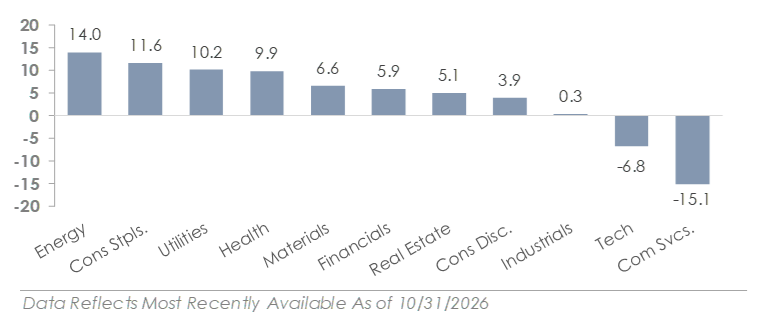
Energy (+14.0%) led all S&P 500 sectors as oil prices rose. Consumer Staples (+11.6%), Utilities (+10.2%), and Health Care (+9.9%) followed, as defensive sectors outperformed. Nine of the eleven sectors traded higher and outperformed the index, while Technology (-6.8%) and Communication Services (-15.1%) traded lower.
Bonds traded higher as Treasury yields declined, with the U.S. Bond Aggregate returning +2.4%. Investment-grade corporate bonds gained +2.0% and outperformed high-yield's +0.3% return as falling yields lifted higher-quality bonds.
International stocks traded lower, led by emerging markets, which declined -8.0% as the selloff in semiconductor stocks weighed on South Korean and Taiwanese stocks. Developed markets were little changed, returning -0.7%.
Market Gains Broaden as Tech Slips
October was a better month for most stocks than the S&P 500's small decline suggests. The index set a new all-time high early in the month, then traded lower as the largest technology companies came under pressure. The pressure carried into the final day of the month, when a weak outlook from Intel weighed on semiconductor and other AI-related stocks. However, the decline was relatively concentrated, with most of the market trading higher. The equal-weighted S&P 500, which gives every company the same weight, outperformed the traditional index by nearly +6%, the widest single-month margin since 2009. The performance gap comes from how the traditional index weights its largest companies, so a pullback in a handful of mega-cap technology stocks can outweigh gains across hundreds of other companies.
The shift centered on artificial intelligence. Earlier this year, investors began asking whether the heavy spending on AI would pay off. October’s earnings reports sharpened that question. Demand for AI infrastructure remains strong, with cloud revenue at the largest technology companies growing rapidly. At the same time, investors drew a clearer line between companies that can pay for their capex with the cash flow their businesses generate and those that rely more on borrowing and issuing new shares. Alphabet’s shares fell sharply after its quarterly spending exceeded the cash its business brought in. In contrast, Microsoft’s shares held steady after the company reported strong cloud growth and generated more than enough cash to cover its spending. Even after October’s market decline, semiconductor stocks are still up more than +50% this year, and the S&P 500 has gained more than +10%. Overall, the month looked less like a retreat from stocks and more like rotation, with gains broadening beyond the largest companies.
Bonds Rally as Treasury Yields Fall
After a difficult third quarter, bonds rebounded in October and provided balance as technology stocks traded lower. The month didn’t start that way. Treasury yields rose in early October on inflation and heavy government borrowing concerns, and the 30-year yield reached its highest level in more than two decades. Yields then reversed lower as investors rotated into bonds during the stock market shift. The 10-year Treasury yield ended the month just below 5%, down from about 5.3% in early October. Because bond prices rise when yields fall, the decline lifted bond returns, with long-term Treasuries gaining more than +5%. Corporate bonds also traded higher, led by investment-grade bonds, which benefited most from falling yields. High-yield corporate bonds produced modest gains as corporate credit spreads widened, particularly among the lowest-rated high-yield borrowers.
The Federal Reserve held interest rates steady at its late-October meeting after raising rates in September, though two policymakers voted for another increase. The split reflects a tension that has run through much of this year. The economy remains on solid footing, growing at a +3.4% annual rate in the third quarter as consumers kept spending and businesses kept investing in AI. However, inflation remains above the Fed's 2% target. Oil prices added to the pressure, rising about +14% in October after attacks on Saudi energy facilities renewed concerns about supply from the Middle East. Against this backdrop, markets expect another rate increase at the December meeting, and the inflation reports between now and then will help shape that decision.
US Market Sector Returns (August in %)
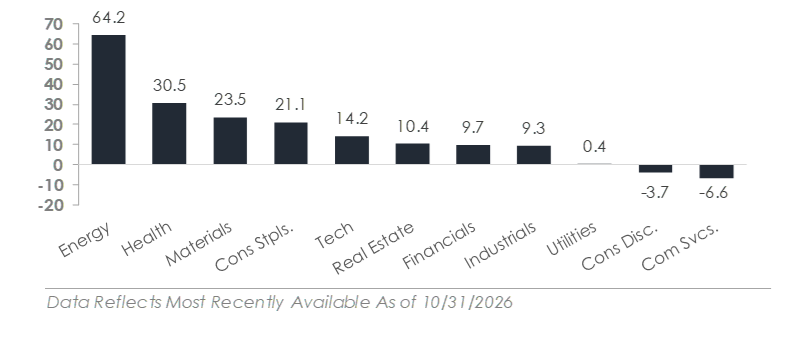
US Market Sector Returns (YTD in %)
Important Disclosures
This material is provided for general and educational purposes only and is not investment advice. Your investments should correspond to your financial needs, goals, and risk tolerance. Please consult an investment professional before making any investment or financial decisions or purchasing any financial, securities, or investment-related service or product, including any investment product or service described in these materials.
Our Insights