
Photo Credit: Getty Images
For most of the past two decades, investors seeking higher returns relied more heavily on stocks. After the 2008 financial crisis, the Federal Reserve kept interest rates extremely low to support the economy, which meant Treasury bonds offered relatively little income. While stocks carried more risk than bonds, they offered earnings growth, dividends, and higher potential returns. The low-interest-rate environment helped popularize the phrase “There Is No Alternative,” or TINA, because bonds weren’t competitive as a source of return. However, the trade-off has changed in recent years. The 10-year Treasury now yields nearly 5.1%, slightly below the S&P 500’s forward earnings yield of 5.3%. For the first time in more than twenty years, bonds offer a competitive alternative to stocks.
Chart 1 compares the 10-year Treasury yield with the S&P 500’s earnings yield. Because stocks don’t pay a fixed interest rate like bonds, the earnings yield offers a way to compare stocks and bonds. The earnings yield shows how much profit S&P 500 companies are expected to generate relative to their market value. For example, a 5.3% earnings yield means S&P 500 companies are expected to generate about $5.30 of earnings for every $100 of market value. When the line in Figure 1 is above zero, the stock market’s earnings yield exceeds the 10-year Treasury yield. When it falls below zero, Treasury yields exceed the earnings yield. For most of the period since the early 2000s, stocks held a sizable yield advantage. Today, the advantage is much smaller.
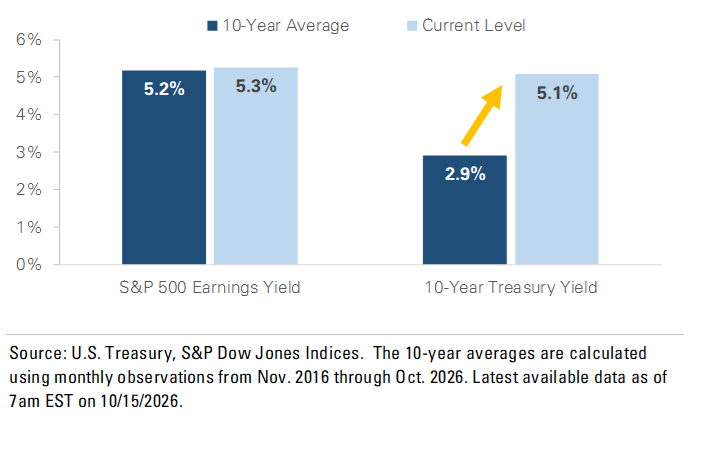
Chart 2 shows that the shift has come almost entirely from higher Treasury yields. The S&P 500’s current forward earnings yield of 5.3% is slightly higher than its 5.2% average over the past decade. In contrast, the 10-year Treasury now yields around 5.1%, about 2.2% above its 10-year average of 2.9%. Treasury yields started rising in 2022 as the Federal Reserve aggressively raised interest rates to bring inflation under control. More recently, Treasury yields have remained elevated as investors weigh persistent inflation, the possibility of additional Fed rate hikes, growing federal deficits, and heavy government borrowing.
The charts don’t necessarily signal that bonds will outperform stocks, and higher Treasury yields come with their own risks. Bond prices can fall when interest rates rise, and inflation can reduce the purchasing power of bond income. Stocks also offer the potential for corporate earnings to grow over time, which is one of the main reasons investors own them for long-term growth. The broader takeaway is that investors have more choices today. For years, low bond yields pushed many investors to rely on stocks to generate higher returns. Today, higher starting bond yields offer a competitive return source and give investors more flexibility to balance income, growth, and risk across their portfolios.
Rising Bond Yields Narrow Stocks’ Advantage
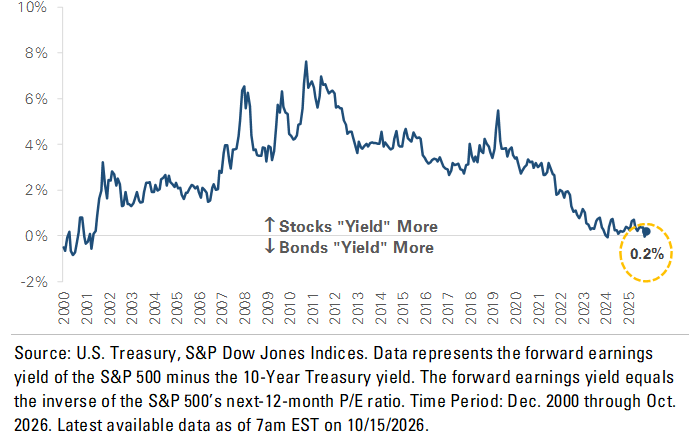
Higher Treasury Yields Narrow the Gap With Stocks
Important Disclosures
This material is provided for general and educational purposes only and is not investment advice. Your investments should correspond to your financial needs, goals, and risk tolerance. Please consult an investment professional before making any investment or financial decisions or purchasing any financial, securities, or investment-related service or product, including any investment product or service described in these materials.
Our Insights