
Stocks Hold Steady Despite a Busy Month of Geopolitical and AI Headlines

Photo Credit: Rod Long, Unsplash
Monthly Market Summary
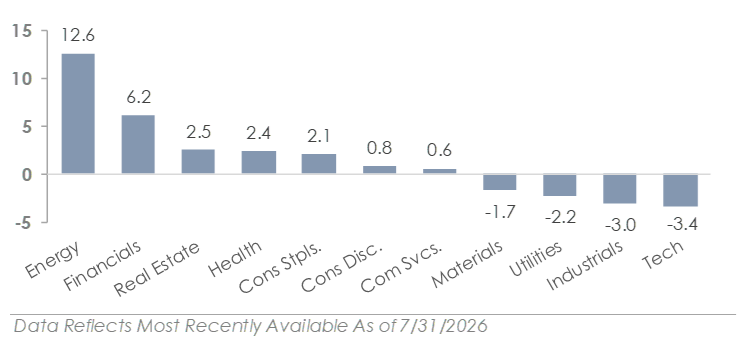
The S&P 500 Index returned -0.1%. Energy led all S&P 500 sectors with a +12.6% return, as geopolitical tensions drove oil higher. Financials (+6.2%) were the second-best performing sector, followed by the defensive trio of Real Estate (+2.5%), Health Care (+2.4%), and Consumer Staples (+2.1%). Technology (3.4%) underperformed as AI stocks gave back some of their gains from earlier in the year.
Bonds traded lower as Treasury yields rose. The U.S. Bond Aggregate returned -1.3% as rising oil prices tied to the U.S.-Iran conflict reignited inflation concerns. Investment-grade corporates underperformed with a -1.5% total return, while high-yield corporates were relative outperformers with a -0.3% return.
International stocks produced mixed returns during July. Developed markets gained +2.0% and outperformed the S&P 500, while emerging markets returned -3.0% and underperformed as the same U.S. tech selloff weighed on South Korean stocks.
Markets Turn Back to the Middle East as Tensions Resurface
The ceasefire from earlier this spring did not hold in July. Renewed conflict between the U.S. and Iran resurfaced the same headlines and concerns from earlier in the year, as uncertainty around the Strait of Hormuz once again raised the risk of reduced oil supply. Late-month headlines pointed to another round of de-escalation, but the conflict’s status remains fluid. The situation matters for the same reason it did the first time around: energy prices feed directly into inflation, and inflation impacts Federal Reserve policy. The Fed ultimately held interest rates steady for a fifth consecutive meeting in July, though a handful of officials pushed for a 0.25% rate hike amid renewed inflation risks.
This isn’t the first time this year that markets have moved through this cycle. There have been multiple mini-cycles of escalating conflict, rising oil prices, and easing tensions, only for the pattern to repeat. The specific headlines and details shift from week to week, but markets have now absorbed the same shock more than once. The Fed’s split decision in late July reflects uncertainty. Officials are debating their next move but are choosing to gather more information rather than reacting to headlines. Despite the headline volatility, the net impact on markets has been limited. The stock market rebounded from the March selloff, and the S&P 500 has returned nearly +10%.
AI Stocks Trade Lower as Investors Shift Focus from Growth to Discipline
Second quarter earnings season kicked off in July, with leading AI companies Alphabet, Microsoft, Meta, Apple, and Amazon all reporting. The group, which is investing heavily in data centers and other AI-related infrastructure, discussed its forecasts and spending plans. For the past two years, the conversation around AI centered on scale. Investors focused on how much companies were spending, how fast they were building, and how big the opportunity could become. This quarter, there was a noticeable shift toward profitability and return on investment.
In a shift from recent quarters, investors pushed back on spending. Companies whose investments are translating into growth, like Microsoft’s cloud business, were rewarded. In contrast, others, whose spending has outpaced their cash flow or weighed on profit margins, saw their stocks trade lower. The market is no longer simply rewarding growth and big spending numbers. It’s asking whether the spending is profitable, or whether rising expenses are outpacing revenue growth. This is a natural and, in many ways, healthy form of discipline. Every major technological buildout eventually reaches a point where investors stop rewarding growth alone and start looking for it to be matched by results. July was the moment that question arrived for AI.
Semiconductor stocks, along with other parts of the AI trade, gave back some of their gains from earlier in the year as investors questioned the sustainability of current spending levels. Despite the semiconductor and AI selloff, the volatility was relatively contained. The equal-weight S&P 500, a proxy for the average S&P 500 stock, set a new all-time high late in the month, and seven of eleven S&P 500 sectors traded higher. Credit spreads, which measure the market’s concern about credit risk, expanded modestly but remain very tight by historical standards. Even after the pullback, semiconductor stocks are still up nearly +60% year-to-date. As for the companies doing the spending, they forecast even higher spending levels in the coming quarters.
US Market Sector Returns (July in %)
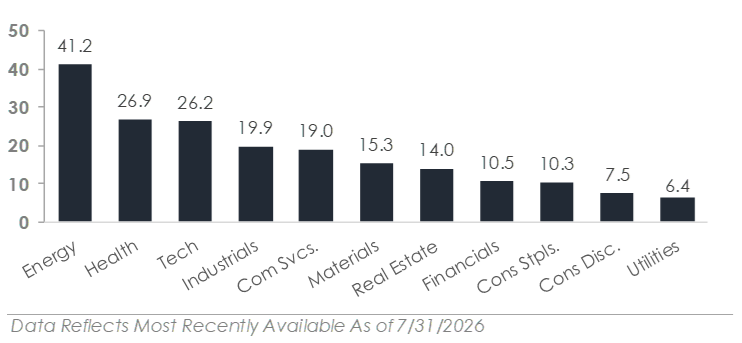
US Market Sector Returns (YTD in %)
Important Disclosures
This material is provided for general and educational purposes only and is not investment advice. Your investments should correspond to your financial needs, goals, and risk tolerance. Please consult an investment professional before making any investment or financial decisions or purchasing any financial, securities, or investment-related service or product, including any investment product or service described in these materials.
Our Insights